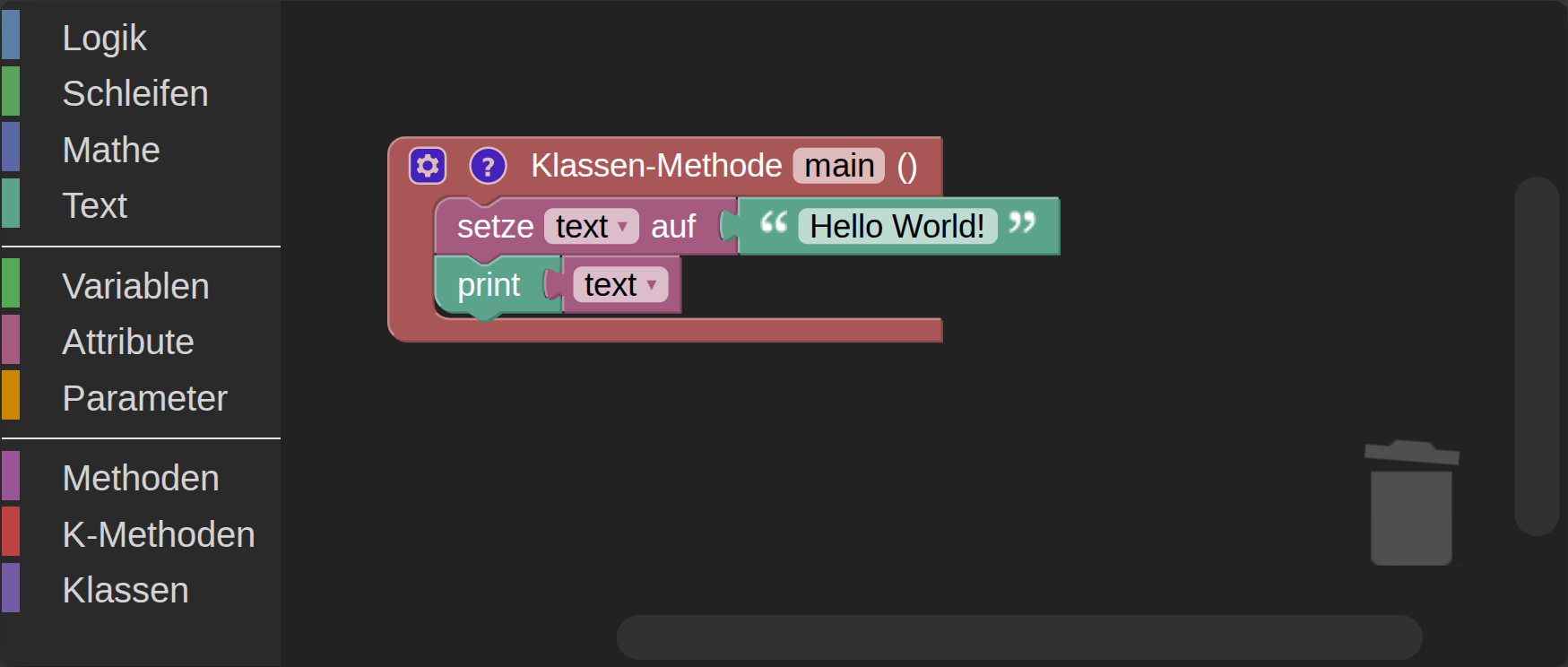
Block-based programming with simultaneous translation to Java
The core of all versions of the app
A Blockly window with a preconfigured toolbox and a real-time translation engine into Java, which is then integrated into two versions of the app.
Currently supported Language Features using Blockly (constantly grwoing)
(Coding directly in Java supports all language features that are available in the OnlineIDE)
Object-Oriented Programming
- Classes & Constructors: Supported — one class per .java-file, instantiation in the same and other classes (
new). - Inheritance &
super(): Partly Supported — single inheritance, overwriting methods andsuper(...)as call inside constructor. Nosuper.method(...)calls, noinstanceof. - Instance vs. Static: Supported — instance/static methods and fields.
- Methods: Supported — methods with/without returns and parameters.
- Method/Constructor Overloading: NOT supported
Variables & Scope
- Local variables: Supported — first assignment can emit typed declaration; subsequent assignments reassigned.
- Instance (object) fields: Supported.
- Static (class) fields: Supported.
- Method parameters: Supported (read-only inside bodies).
Types & Type System
- Primitive types: Supported —
int,double,boolean, andString(string-like). - Reference types: Supported —
Object, user-defined classes. - Type inference: Best-effort from block connections; cross-class call-site hints improve inference.
- Fallback:
Objectused when type unknown; LCA used for mixed-class cases. - Explicit typing: Supported — explicit type prefixes (e.g., “int count”) override inference.
Control Flow
- Conditionals: Supported —
if/else if/else - Loops: Partly Supported —
while, repeat N (count),for(range), NO for-each - Flow control: Supported —
break,continue.
Methods & Calls
- Method declaration: Supported — define/call methods with/without returns and arbitrary number of parameters
- Method calls: Supported — call own methods or such of specific objects and static calls for methods of any class in the project.
Collections & Arrays
- NOT supported (but planned in near future)
Strings & Text
- Literals & concatenation: Supported.
- Common ops: Supported — length, substring, charAt, indexOf/lastIndexOf, case, trim, replace, reverse, count.
- I/O for demos: Partly supported: Console print; NO input (but planned in near future)
Math & Random
- Arithmetic & math functions: Supported — + - * /, pow, sqrt, trig, logs, rounding.
- Random & helpers: Supported — random int/float, more planned in near future
Colours & Utilities
- NOT supported (but planned in near future)
Standard Library
- Uses common Java classes suitable for student exercises:
Math,StringBuilder,Random, more is planned
Limitations / Pedagogical Notes
- Exceptions / try-catch: Not provided — not suitable for exception-handling lessons.
- File I/O & filesystem: Not available.
- Concurrency / threads: Not supported.
- Advanced generics: No supported; generics teaching is constrained.
- Deep Java APIs (graphics, networking, advanced collections): Not exposed by default.
- Generated helpers: Some operations use helper methods (e.g., median, prime), which differ from minimal hand-written implementations.
Toolbox
- The toolbox can be configured to reduce supported features to lower the floors of the App.
Quick teacher decision guide
- Basic OOP, control flow, collections, strings, and typing: Yes.
- Exception handling, file I/O, concurrency, advanced generics, or deep API topics: No / Limited.
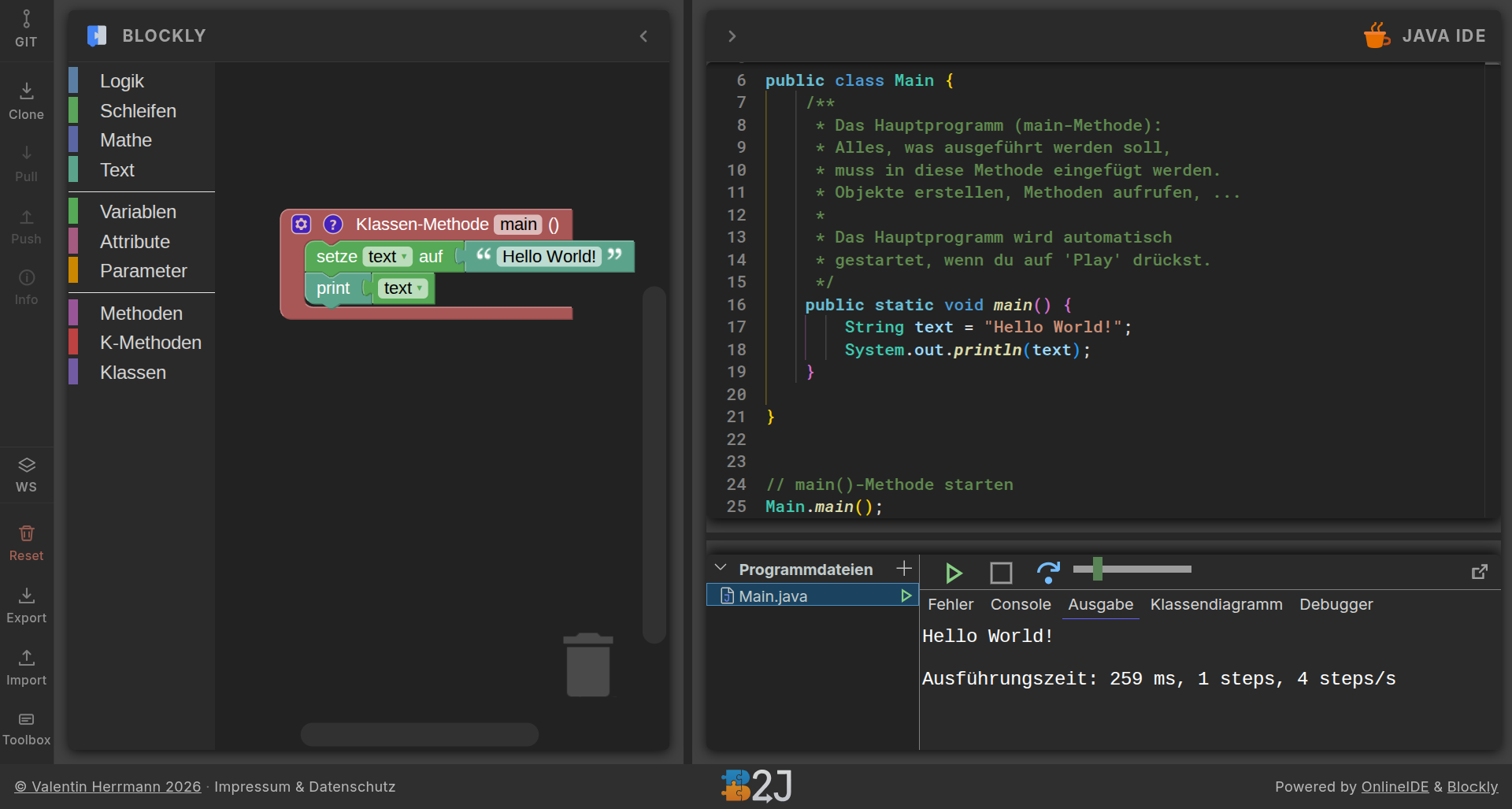
Blockly2Java: b2j.valentin-herrmann.com
A web app which uses a slightly modified version of Martin Pabst’s OnlineIDE together with Blockly to provide a feature-rich, OS-independent, dual-language online workspace.
Core features
- Free and open-source. Contributions welcome — open a pull request on GitHub.
- Multiple classes
- Debugger (with pop-out option)
- UML class diagram generation
- Main method: automatically detected and prepared for execution
- Markdown files are displayed in read-only mode and can, for example, contain exercise statements.
- Blocks, Java, or both: Start coding a class with Blockly and optionally continue with Java, or work exclusively in either language.
- Git integration with a reduced feature set (clone, pull, commit + push) for public and private repositories.
- Toolbox configuration: Use the integrated visual editor or JSON files to define available blocks and categories. Comes with template configurations stored as .json and can be shipped via Git.
- Local import/export as *.b2j files (internally a *.zip; rename to access contents).
- Client-side data only: No user data is stored on servers; data remains in the user’s browser to support privacy. For technical security reasons, the visitor’s IP address is logged.
- In the future, it’s planned to support the full OnlineIDE graphics library also from Blockly (not just from Java code).
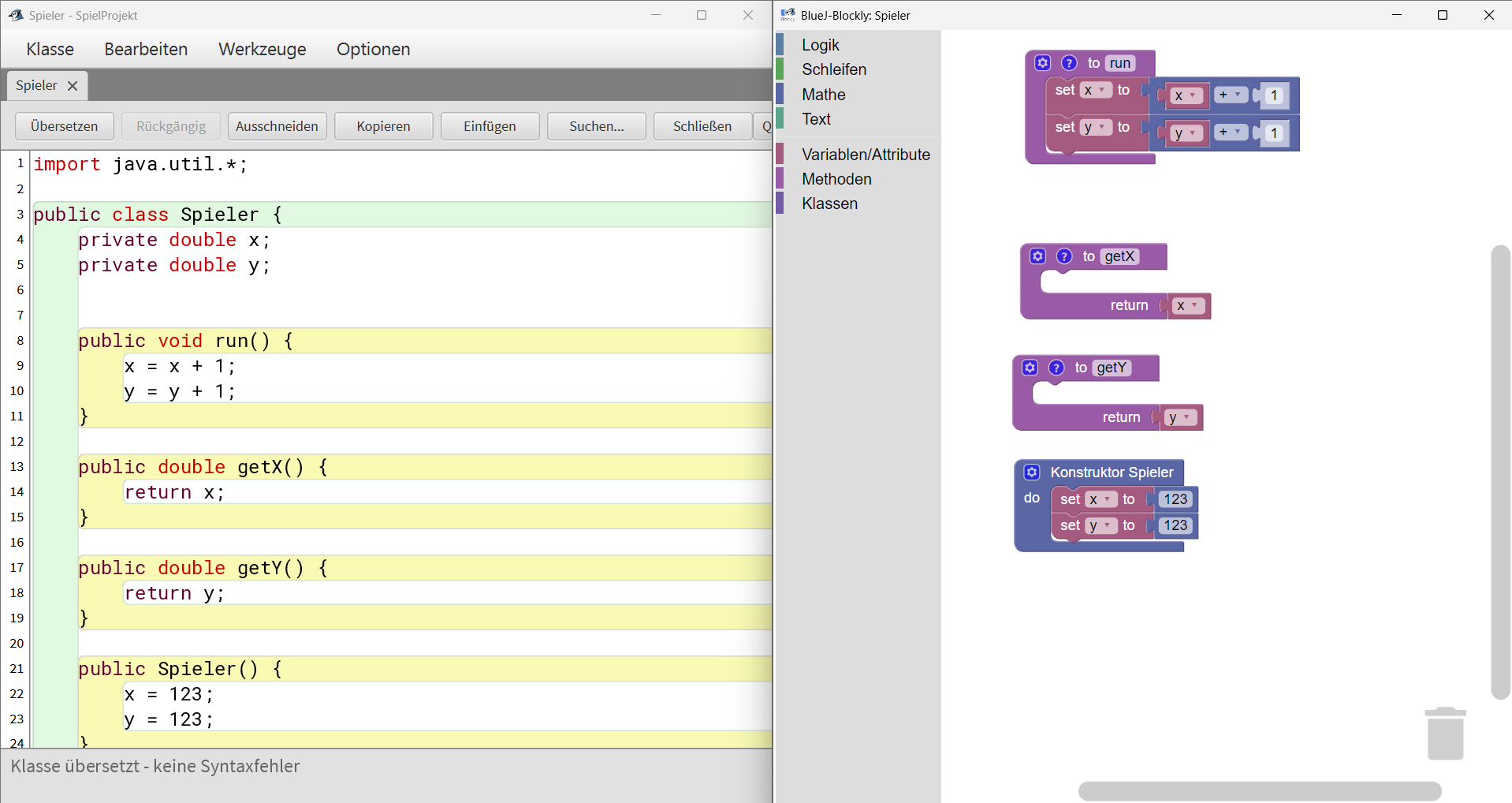
BlueJ Blockly Extension (BBE)
The BlueJ Blockly Extension is an add-on for the educational IDE BlueJ and can be installed on any system with BlueJ. For Windows, an MSI installer is compiled for each release.
Core features
- Free and open-source. Contributions welcome — open a pull request on GitHub.
- Block code is fully translated to Java and has no runtime dependency on Blockly; the full BlueJ feature set for Java remains available.
- Reduced Java subset suited to the needs of 9th graders.
- In templates, classes can be explicitly locked to prevent opening them with Blockly.
- The extension is installed with a Gameboard library for easy game creation, with online documentation and a set of graphics that can be extended by users.
BBE is currently not actively maintained and does not support the latest translation features.